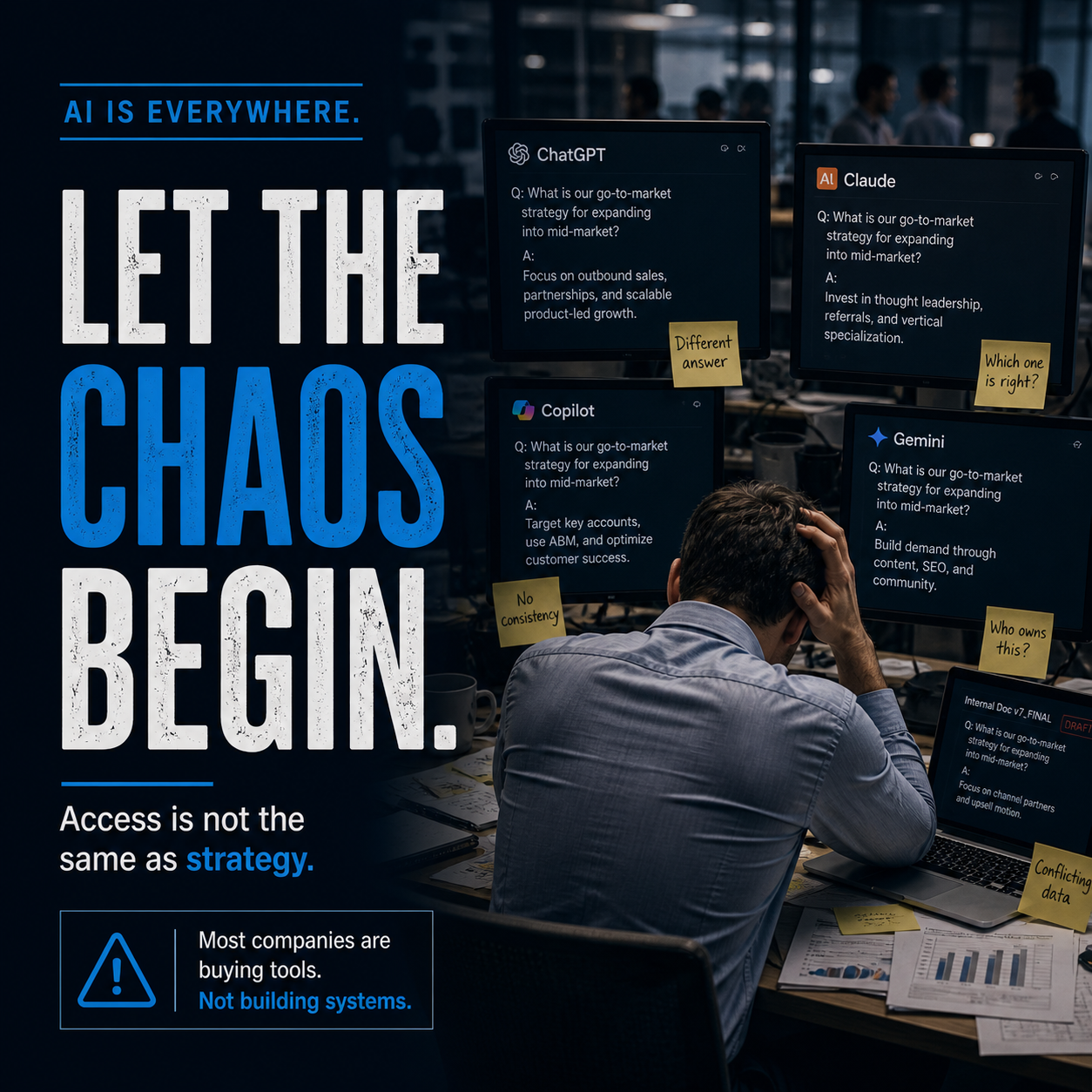
Every week, another company decides it is “doing AI.”
They buy licenses. Turn on Copilot or Claude. Announce the rollout. Encourage adoption. Then call that an AI strategy.
It is not. It is a purchasing decision. And that distinction is costing businesses more than they realize.
Access Is Not the Same as Leverage
Individual AI tools are genuinely useful. A strong operator with good judgment can get real output from them: faster analysis, better drafts, more done in less time. That value is real, and it explains why the market is moving so aggressively.
But the fact that something works well for an individual does not mean it scales across a business.
AI is a force multiplier. Force multipliers amplify what is already there. Give AI to a high performer and they often get materially better. Give it to someone with weak judgment and you get more bad output, delivered faster and with more confidence.
AI amplifies judgment. It does not standardize it.
More Seats Create More Chaos
When AI rolls out as an individual tool, every employee builds their own prompts, their own files, their own workflow. Two people ask the same business question and get different answers. Nobody notices until a client does.
Client communication drifts. Recommendations vary by who answered the email. Institutional knowledge does not accumulate. What looks like productivity is actually inconsistency running at higher speed.
That is not scale. That is variation disguised as productivity. (And we wonder why operations do not improve after the rollout.)
We see this pattern in nearly every new client assessment. The tool adoption is high. The operational improvement is not.
The Question Most Executives Are Not Asking
The logic sounds reasonable: if one good employee gets real value from AI, give everyone access and multiply it across the organization. But that assumes the tool is the strategy.
It is not.
The real question is not “How do we get everyone access?” It is “How do we make AI produce consistent, governed, REPEATABLE value across the business?” Those are not the same question. Most companies are only answering the first one.
Individual AI helps a person work faster. Platform-based AI helps a company work better.
Until that distinction is made, AI stays a personal productivity layer: helpful in spots, impressive in demos, but limited as a business capability. If your best people leave, the capability walks out with them. That is local optimization, not a durable operating model.
Buying seats is easy. Building a real AI strategy is hard.
Most companies are still doing the easy part and calling it a strategy.