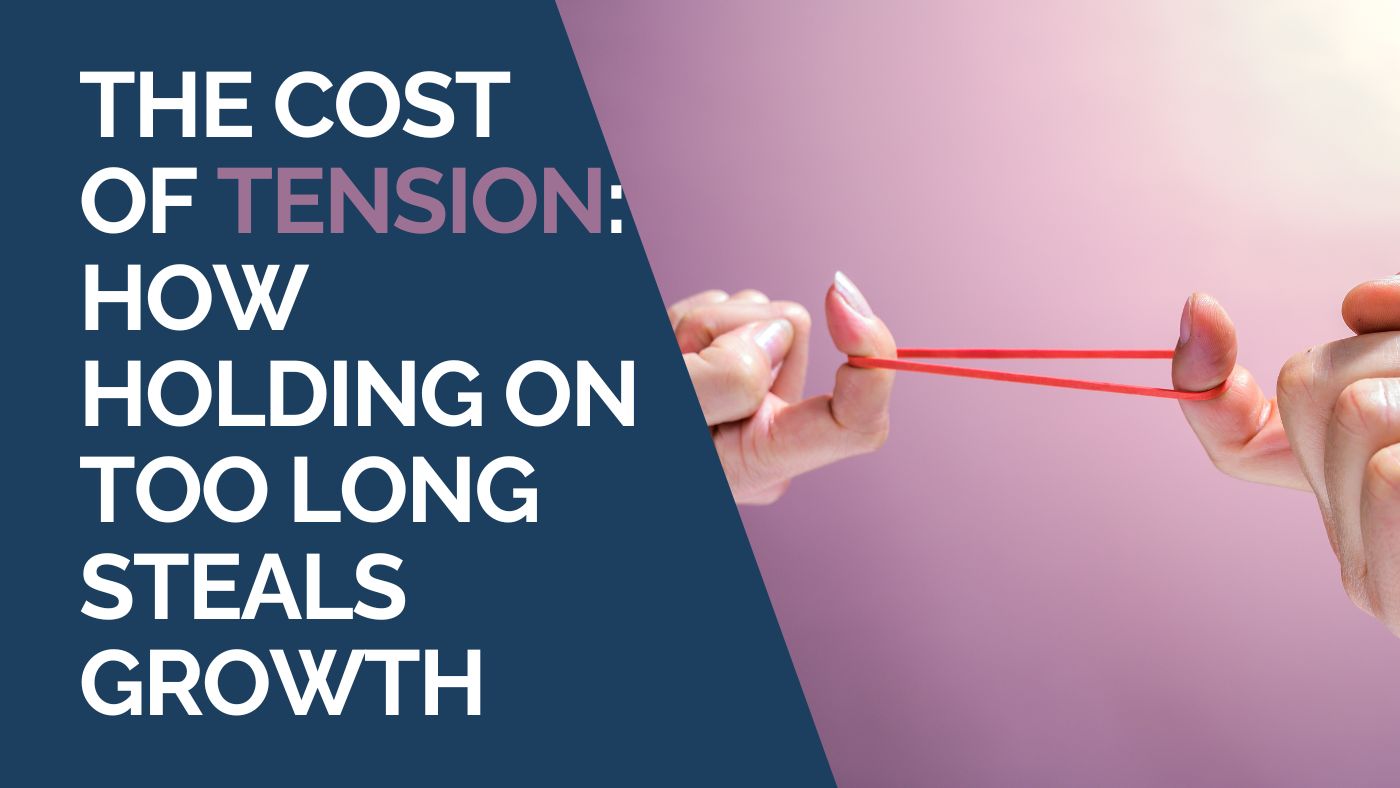
Every successful business thrives in a constant state of tension.
On one end of the rubber band is what made us successful: the current revenue model, the proven processes, the dependable services, the cultural norms that feel safe.
On the other end is what we could become: new markets, new capabilities, innovation, higher-margin offerings, smarter use of technology, deeper strategic value to clients.
Both ends matter. But the tension between them is where many organizations lose momentum.
As time passes, the gap between “where we are” and “what we could achieve” naturally widens. Markets evolve. Technology accelerates. Client expectations rise. Competitors experiment. The rubber band stretches further.
What most businesses fail to recognize is not the existence of this tension but the cost of staying under tension too long.
The Organizational Cost of Tension
When leadership senses opportunity but hesitates to disrupt what works, several things begin to happen:
- Strategic conversations become circular.
- Teams feel uncertainty but lack direction.
- Innovation stalls under operational pressure.
- Anxiety rises without visible progress.
- “Organizational noise” increases in the form of more meetings, debates, partial initiatives, and competing priorities.
From the outside, the company may appear stable. Internally, however, energy is being consumed by unresolved tension.
The longer the rubber band stretches without release, the more strain it places on culture, clarity, and confidence.
Eventually, one of two things happens:
- The band snaps (reactive change forced by crisis), or
- The organization gradually relaxes its ambition and normalizes stagnation.
Neither is ideal.
Reducing Time “Under Tension”
The solution is not eliminating tension because some tension is healthy. It signals aspiration. It indicates awareness of opportunity.
The key is reducing the duration of unresolved tension.
High-performing organizations do this by:
- Making ambition explicit. Clearly defining the “other end” of the rubber band so teams know what the stretch is for.
- Creating structured experimentation. Testing new ideas quickly instead of debating them indefinitely.
- Separating core stability from growth engines. Protecting what works while deliberately funding what’s next.
- Rewarding movement, not perfection. Encouraging progress over prolonged analysis.
Most importantly, they build a culture that expects continuous recalibration. Growth is not a distant future event; it’s a practiced rhythm.
The Business Impact
Companies that reduce time under tension move faster, experience less internal friction, and convert strategic conversations into measurable outcomes.
They experience:
- Lower organizational anxiety
- Higher clarity of direction
- Faster innovation cycles
- Greater resilience in market shifts
In contrast, businesses that cling too tightly to current success often discover that what once made them strong slowly becomes the very force limiting their next stage of growth.
The rubber band will stretch whether we acknowledge it or not.
The Benefits of a Strong IT Partner
A strategic IT Partner can significantly reduce the “time under tension” by helping organizations move from aspiration to execution faster and with less noise.
Here’s how:
- Turning Possibility into Practical Roadmaps
When leadership sees opportunity (AI, automation, data visibility, workflow optimization), tension builds because the “how” is unclear. A strategic IT Partner translates ambition into phased, executable plans by aligning technology investments directly to business outcomes instead of abstract innovation. - Protecting the Core While Enabling the Future
One major source of tension is fear of destabilizing what already works. A mature IT Partner stabilizes and optimizes the core IT environment (“run the business”) while creating controlled environments to test and deploy new capabilities (“change the business”). This separation reduces risk anxiety. - Reducing Organizational Noise
Without technical clarity, growth conversations become circular. A strategic IT Partner brings structure in the form of governance, prioritization frameworks, measurable KPIs, which replaces debate with decisions. - Accelerating Experimentation
Rather than overanalyzing new initiatives, a strong IT Partner enables small, rapid pilots: AI workflows, automation use cases, data dashboards, collaboration redesigns. Faster feedback reduces the duration of uncertainty. - Providing an Outside Strategic Lens
Internal teams often feel the pull between preserving what works and pursuing what’s next. A mature IT Partner provides perspective, pattern recognition, and experience from other organizations navigating similar inflection points and shortening the learning curve. - Embedding a Culture of Managed Evolution
The best IT Partners don’t just “support technology.” They help clients build a repeatable rhythm of assessment, prioritization, implementation, and refining tension into a managed cycle rather than a chronic condition.
Ultimately, tension itself is not the problem. Unmanaged tension is.