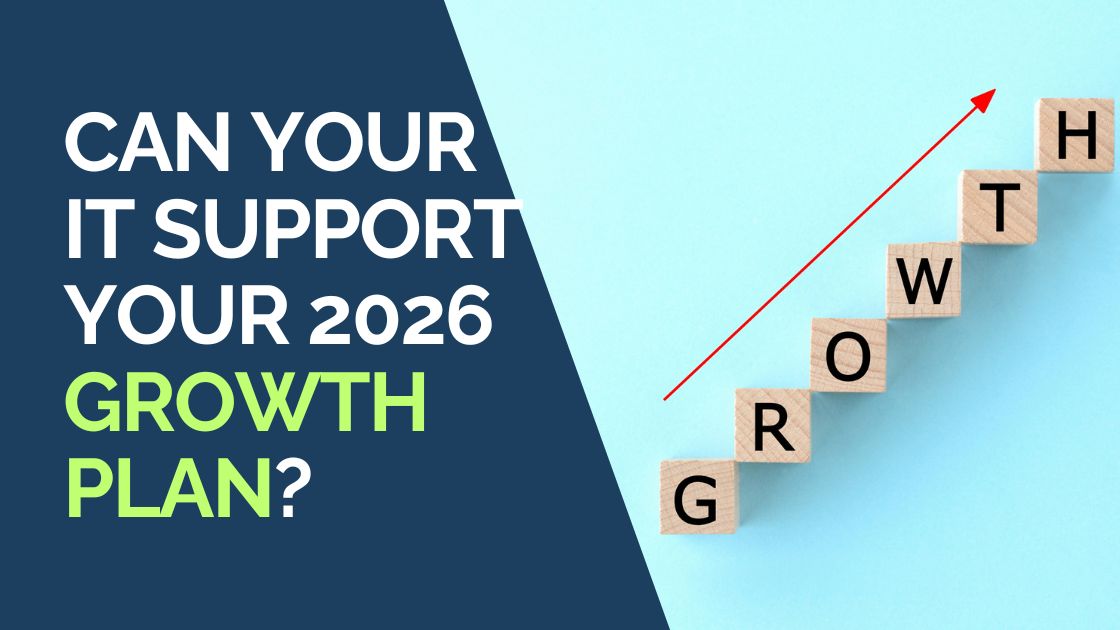
Most growth plans look solid on paper.
More revenue. More clients. More people. More locations. More systems working together.
What often gets missed is whether the company’s IT can actually carry that load.
For many businesses, IT is fine for today but quietly becomes the bottleneck once growth accelerates. Problems do not show up during planning. They show up mid-year when hiring stalls, systems slow down, security incidents spike, or leadership realizes no one truly owns the technology strategy.
Before 2026 arrives, business leaders should be asking one direct question.
“Can our IT support the company we are planning to become?“
Growth exposes IT weaknesses
When a business is stable, small cracks stay hidden. Growth puts pressure on everything at once.
More users means more onboarding, access control, training, and support.
More data means higher security risk and compliance exposure.
More systems mean more complexity and more chances for failure.
More revenue means more downtime cost when something breaks.
IT that was built to “keep things running” often cannot scale to “support growth.”
This is where leadership frustration begins. Teams feel slower instead of faster. Decisions get delayed. Risk increases while confidence drops.
5 warning signs your IT growth plan will not scale into 2026
If any of these sound familiar, your growth plan may already be outpacing your IT.
- Your IT provider is reactive instead of proactive: If conversations are mostly about tickets, outages, or renewals, there is no strategic planning happening.
- Onboarding new employees feels messy or slow: Growth requires hiring. Hiring requires repeatable onboarding that does not disrupt operations.
- Security feels like a hope, not a plan: Many businesses rely on basic tools without a clear security strategy tied to business risk.
- Leadership cannot clearly explain the IT roadmap: If no one can answer what IT is working toward over the next 12 to 24 months, growth is being supported by luck.
- IT decisions are made tool by tool: Growth requires systems working together, not disconnected purchases reacting to short-term problems.
Why traditional IT support breaks down during growth
Most IT support models were designed to maintain, not enable.
They focus on fixing what is broken.
They respond to requests as they come in.
They sell tools without owning outcomes.
They measure success by response time, not business impact.
That approach works until the business starts moving faster.
At that point, IT must shift from support to strategy.
What growth-ready IT actually looks like
IT that supports growth does a few things consistently.
- It plans ahead: Technology decisions are made in the context of business goals, hiring plans, and revenue targets.
- It standardizes processes: Onboarding, security, access, and support follow clear, repeatable playbooks.
- It reduces friction: Employees can work efficiently without fighting systems or waiting on fixes.
- It manages risk intentionally: Security is designed around business exposure, not fear-based checklists.
- It gives leadership visibility: Executives know where technology is helping growth and where it could become a constraint.
This is not about having more tools. It is about having a proven way to manage technology as the business evolves.
The real question leaders should ask before 2026
Instead of asking, “Is our IT working?”
The better question is, “Is our IT helping us grow or quietly slowing us down?”
If IT cannot support hiring, expansion, security, and operational efficiency at the same time, growth becomes harder than it needs to be.
That is when companies start looking for a different approach.
How ProSafeIT supports growth-focused businesses
ProSafeIT was built for organizations that have outgrown basic IT support.
It combines people, processes, and tools into a repeatable playbook that aligns technology with business growth.
The focus is not on selling software or reacting to tickets.
The focus is on helping leadership move forward with confidence.
If 2026 is a year you expect your business to grow, your IT should already be preparing for it.