
Most business owners evaluate their MSP based on presentations, cybersecurity claims, certifications, and sales pitches.
I think there’s a much simpler test.
Look at the invoice.
The invoice often tells you more about your provider’s business model than any sales presentation ever will.
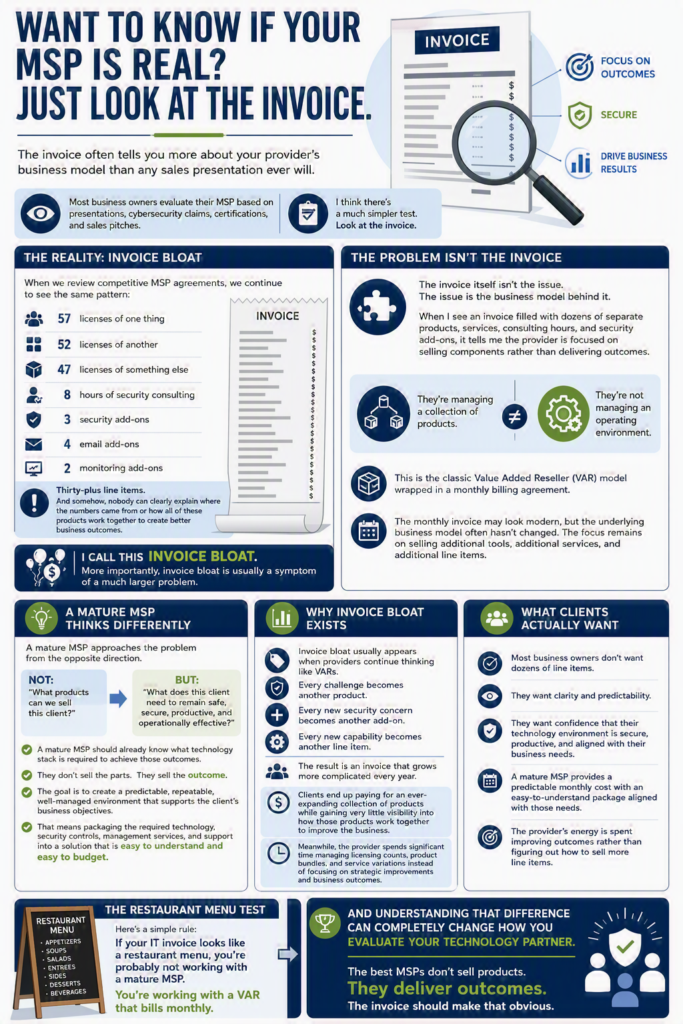
When we review competitive MSP agreements, we continue to see the same pattern:
- 57 licenses of one thing
- 52 licenses of another
- 47 licenses of something else
- 8 hours of security consulting
- 3 security add-ons
- 4 email add-ons
- 2 monitoring add-ons
Thirty-plus line items.
And somehow, nobody can clearly explain where the numbers came from or how all of these products work together to create better business outcomes.
I call this invoice bloat.
More importantly, invoice bloat is usually a symptom of a much larger problem.
The Problem Isn’t the Invoice
The invoice itself isn’t the issue.
The issue is the business model behind it.
When I see an invoice filled with dozens of separate products, services, consulting hours, and security add-ons, it tells me the provider is focused on selling components rather than delivering outcomes.
They’re managing a collection of products. They’re not managing an operating environment.
This is the classic Value Added Reseller (VAR) model wrapped in a monthly billing agreement.
The monthly invoice may look modern, but the underlying business model often hasn’t changed.
The focus remains on selling additional tools, additional services, and additional line items.
A Mature MSP Thinks Differently
A mature MSP approaches the problem from the opposite direction.
The question isn’t:
“What products can we sell this client?”
The question is:
“What does this client need to remain safe, secure, productive, and operationally effective?”
A mature MSP should already know what technology stack is required to achieve those outcomes. They don’t sell the parts. They sell the outcome.
The goal is to create a predictable, repeatable, well-managed environment that supports the client’s business objectives. That means packaging the required technology, security controls, management services, and support into a solution that is easy to understand and easy to budget.
Why Invoice Bloat Exists
Invoice bloat usually appears when providers continue thinking like VARs. Every challenge becomes another product. Every new security concern becomes another add-on. Every new capability becomes another line item.
The result is invoice bloat that grows more complicated every year.
Clients end up paying for an ever-expanding collection of products while gaining very little visibility into how those products work together to improve the business. Meanwhile, the provider spends significant time managing licensing counts, product bundles, and service variations instead of focusing on strategic improvements and business outcomes.
What Clients Actually Want
Most business owners don’t want dozens of line items. They want clarity and predictability. They want confidence that their technology environment is secure, productive, and aligned with their business needs.
A mature MSP provides a predictable monthly cost with an easy-to-understand package aligned with those needs. The provider’s energy is spent improving outcomes rather than figuring out how to sell more line items.
The Restaurant Menu Test
Here’s a simple rule:
If your IT invoice looks like a restaurant menu, you’re probably not working with a mature MSP.
You’re working with a VAR that bills monthly.
And understanding that difference can completely change how you evaluate your technology partner.
The best MSPs don’t sell products.
The invoice should make that obvious.