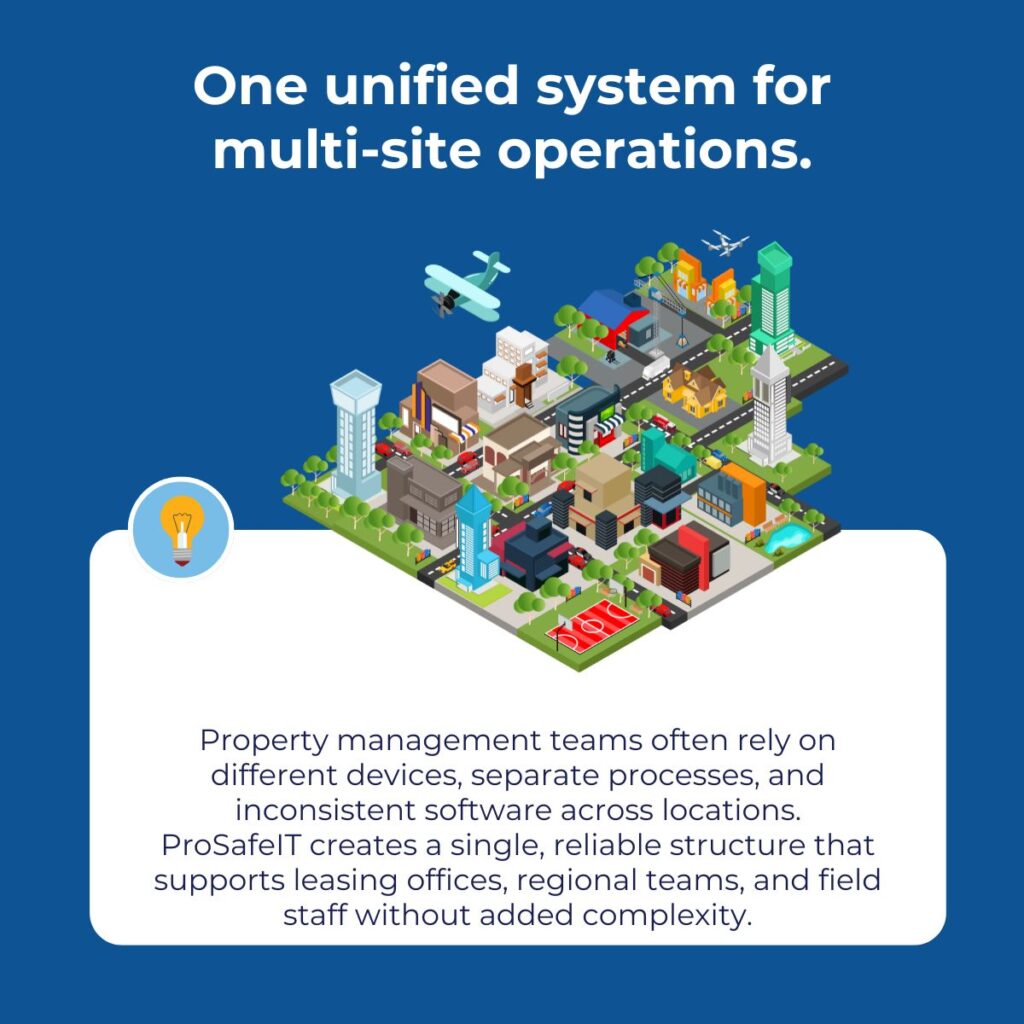
Property management firms operate across multiple locations, properties, and teams. Leasing offices, maintenance crews, accounting teams, and regional managers all rely on technology to stay coordinated and deliver consistent service to residents and owners.
Listen to a Deep Dive Audio Summary
Yet in many firms, property management IT responsibilities sit across scattered tools, aging equipment, and informal processes that no one fully owns.
This creates slowdowns, frustrated employees, compliance risks, and operational inconsistency that become harder to manage as the portfolio grows.
A structured property management IT model changes this. It gives firms a predictable foundation that supports leasing operations, maintenance workflows, financial reporting, resident communication, and team collaboration without creating unnecessary complexity.
Below is a deeper look at the specific challenges property management teams face and how a consistent IT framework solves them.
Leasing teams need reliable systems that do not interrupt the office workflow
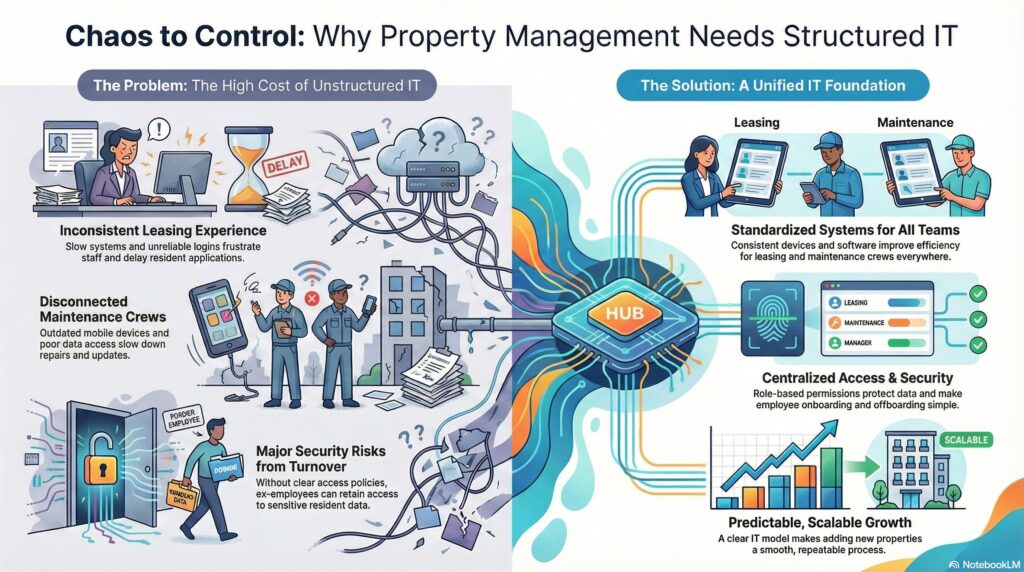
Leasing staff depend on consistent access to property management software, online applications, digital documents, and resident records. When workstations are slow or logins are unreliable, the leasing experience suffers. Prospects wait longer. Applications get delayed. Staff lose valuable time troubleshooting instead of serving walk-ins.
In many leasing offices, technology varies from site to site. Some locations have newer devices while others are years behind. Wi-Fi speeds differ. Shared computers get cluttered. Passwords are stored informally or remembered by one person.
A structured property management IT setup standardizes devices, access, and office systems so every location operates the same way. Leasing staff can serve residents faster, access their tools without interruption, and move between properties without adjusting to different setups.
Consistency improves both resident experience and operational results.
Maintenance teams rely on clear comms and fast access to info
Maintenance teams move constantly. They need quick access to service tickets, property information, vendor contacts, and resident details. They also need reliable mobile devices that sync with the office and prevent delays in completing work.
When property management IT is inconsistent, maintenance teams deal with:
- mobile devices that are outdated or unmanaged
- ticketing systems that do not sync properly
- unreliable email access on the go
- files and photos stored in random locations
- a lack of centralized documentation
This slows down repairs, increases resident complaints, and creates confusion for regional managers trying to track completion times.
A unified IT foundation solves this by managing all mobile devices, applying standard security policies, and connecting maintenance teams to the same Microsoft 365 environment as the office. Everyone has the information they need, when they need it, without relying on guesswork.
Access control is critical when employees turn over frequently
Property management firms experience higher than average turnover in leasing, maintenance, and administrative roles. Without a clear access policy, accounts are often left active, passwords are reused, and shared logins are passed from one employee to another.
This creates two major risks:
- unauthorized access to resident or financial information
- gaps in accountability and auditability
A structured access framework built on Microsoft 365 fixes this. Roles and permissions are tied to job functions. When an employee leaves, access is removed immediately. When a new hire starts, they receive role based permissions without anyone having to guess.
This protects sensitive resident data and simplifies compliance for ownership groups and management partners.
Growth increases complexity unless systems grow with it
Adding a new property or location should be a predictable process. In many firms, it is not. Each new site comes with different computers, old wiring, varied internet providers, and legacy habits. Leadership often has no visibility into what each location uses or how well it performs.
Over time, this leads to:
- inconsistent operations
- rising support needs
- unreliable financial reporting
- slow communication between sites
- costly hardware replacements
A consistent property management IT model removes this friction by establishing clear standards for devices, licensing, connectivity, and support. Each new location is brought online using the same proven process, giving leadership confidence that operations will run smoothly from day one.
Resident and owner data must be protected with more than passwords
Property management firms handle sensitive data. Applications, renewals, ACH data, vendor contracts, maintenance histories, and internal financials move through the system daily. Storing this information across desktops, email threads, or outdated servers puts the firm at unnecessary risk.
Microsoft 365, when setup correctly, provides a secure foundation for identity, file storage, compliance, and controlled access.
When applied consistently across the firm, it reduces the chance of data loss, accidental exposure, or unauthorized access. This helps protect the firm’s reputation and strengthens trust with owners and residents.
Onboarding should be simple, fast, and predictable
When a new leasing agent or maintenance employee starts, they need immediate access to their tools. Delays in equipment, logins, or training slow down the entire property. Many firms rely on improvised setups that vary widely between regions.
A structured onboarding process gives new hires:
- a configured device that works out of the box
- correct access based on their role
- consistent tools across the entire firm
- clear support pathways
This allows them to be productive on day one rather than waiting for systems to be set up.
ProSafeIT gives property management firms the foundation they have been missing
Property management firms do not fail because of bad staff or poor policies. They struggle because the complexity of their portfolio grows faster than their internal systems can handle. ProSafeIT builds a strong foundation for:
- hardware lifecycle management
- device standardization
- access control and user setup
- leasing and maintenance team coordination
- secure communication across properties
- consistent workflows and onboarding
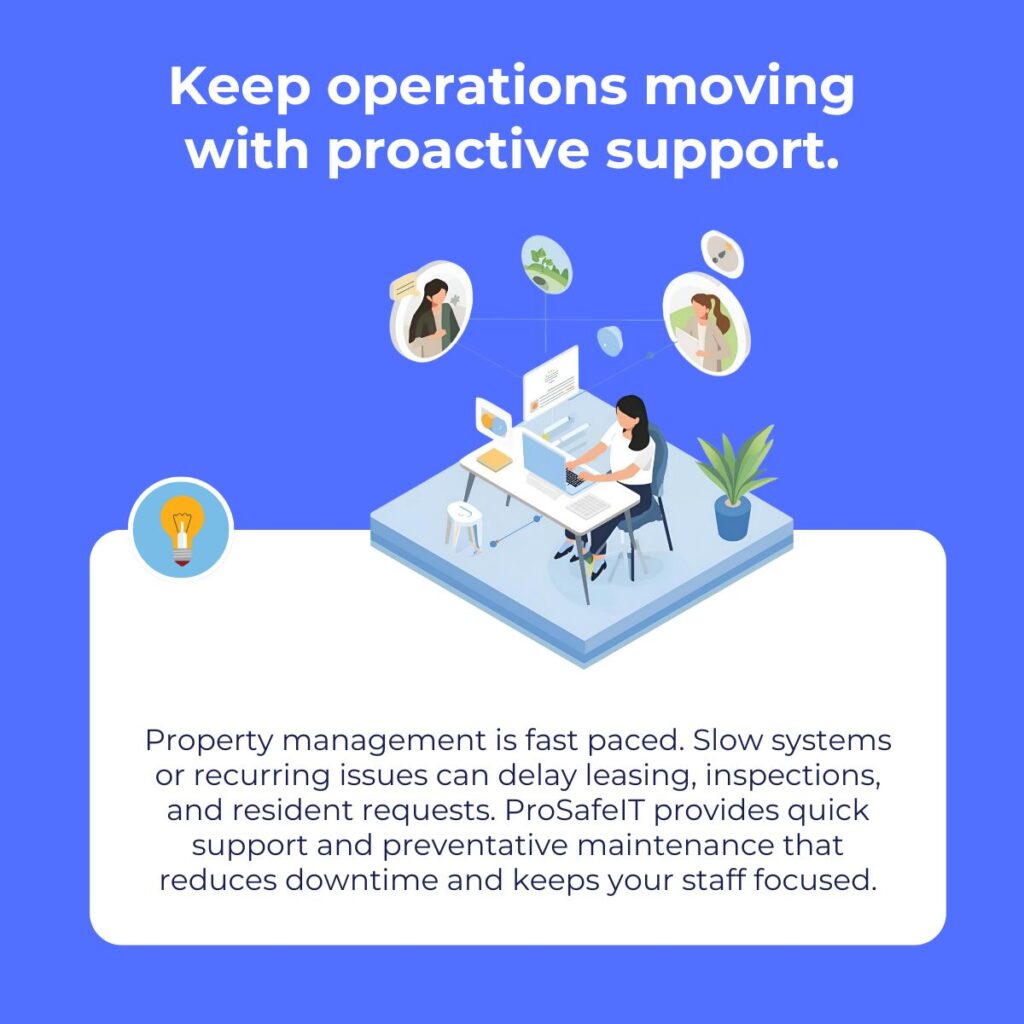
- proactive support that reduces downtime
This improves resident experience, reduces operational waste, strengthens security, and helps firms grow without introducing unnecessary complications.