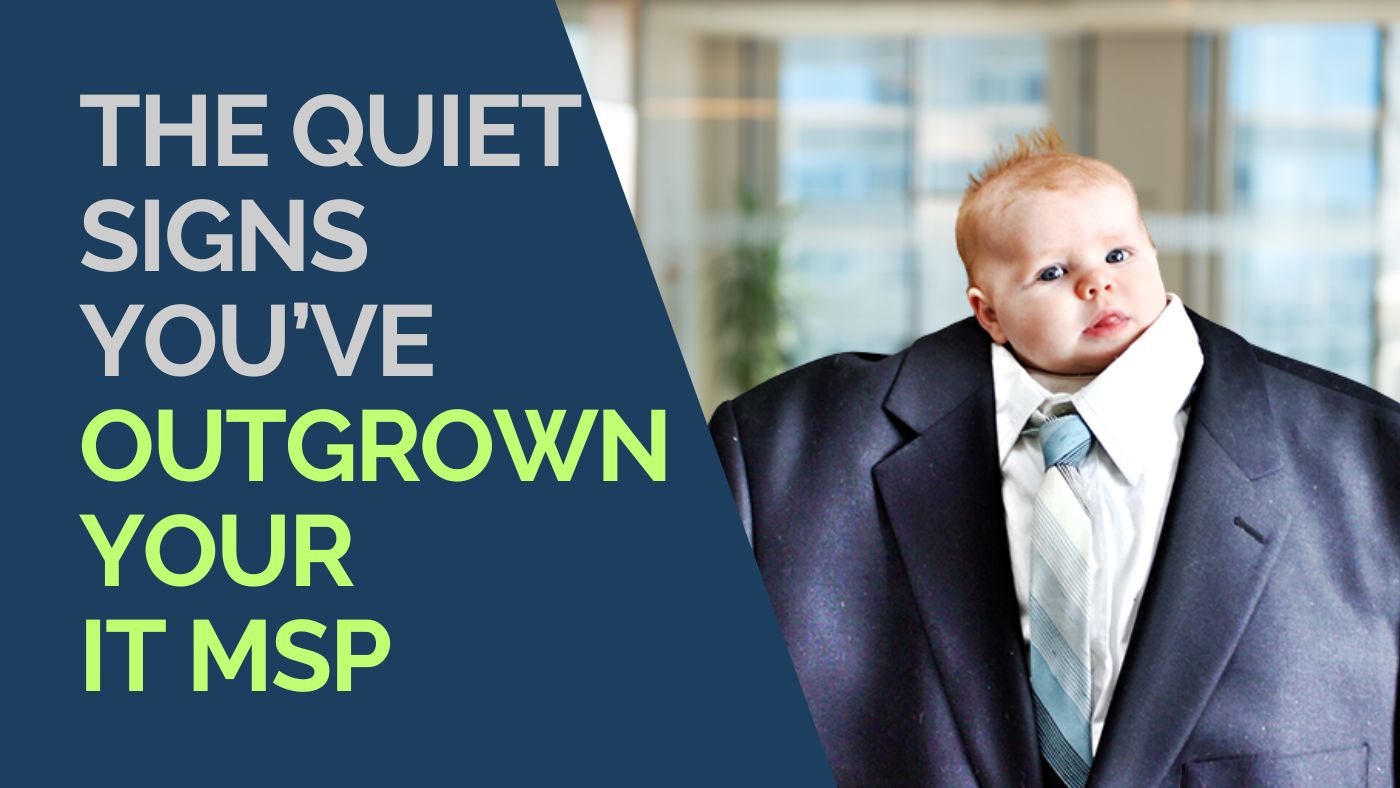
Most companies do not wake up one morning and decide they need a new IT MSP.
What usually happens is quieter than that.
Things still mostly work. Emails go through. New hires eventually get set up. Tickets get closed. On paper, nothing is “broken.”
But confidence starts to slip.
Leaders hear more complaints from staff. Billing feels harder to predict. Response times stretch just enough to be noticed. A security scare or near-miss raises uncomfortable questions. And someone on the operations side starts wondering whether the business has simply grown past the level of support it once needed.
If that sounds familiar, you may not have an IT problem at all.
You may have outgrown your IT MSP.
What “Outgrowing Your IT MSP” Actually Looks Like
Outgrowing an IT MSP is rarely dramatic. It shows up as friction. Friction costs time, attention, and trust.
Here are the signs we hear most often from growing businesses.
Internal complaints reach leadership
When a company is small, IT frustrations stay local. Someone grumbles, a ticket gets filed, and life moves on. As the company grows, those complaints start bubbling up to operations leaders and executives. Not because people are dramatic, but because interruptions compound when more people depend on the same systems.
Tickets feel slower, even if they are still within contract
Your IT MSP may technically be meeting response times. That does not mean those timelines still work for your business. When headcount increases and roles become more interdependent, delays that once felt manageable now block revenue, service delivery, or deadlines.
Billing feels unpredictable
As your environment grows more complex, invoices often follow. Extra licenses, add-on services, surprise charges, and line items that require explanation start to appear. Leaders do not like surprises, especially when they affect forecasting and margins.
Near misses change the conversation
A phishing attempt that almost worked. A server that almost ran out of space. A backup that worked just in time. These moments do not always cause damage, but they do erode confidence. They raise the question no one wants to ask out loud. Are we actually prepared, or are we just getting lucky?
IT decisions feel reactive
Instead of planning ahead, IT discussions start sounding like damage control. The focus shifts to fixing what broke instead of preparing for what is coming. That is usually when operations leaders realize IT has become a constraint instead of a support system.
None of these mean your IT MSP is incompetent. In many cases, they are doing exactly what they were hired to do.
The issue is fit.
Why Good IT MSPs Struggle with Growing Companies
This part matters, because it reframes the problem.
Most traditional IT MSPs are built for stable businesses that want to stay roughly the same size. These are often lifestyle businesses. They value consistency, predictable workloads, and a steady pace of change.
That model works well when:
- Headcount grows slowly
- Systems change infrequently
- Risk tolerance is higher
- Leadership wants IT to be quiet and invisible
There is nothing wrong with that.
The challenge comes when a business starts growing faster.
Growth demands different economics. It requires economies of scale and economies of scope. Many smaller MSPs simply do not have them.
Without scale, support capacity is limited. As ticket volume rises, response slows. The team is stretched thinner, even if effort stays high.
Without scope, expertise is narrow. As environments become more complex, the MSP relies more on vendors, third parties, or workarounds. That adds handoffs, delays, and cost.
This does not make the MSP bad at their job.
It means they were not built for what your business is becoming.
The Growth Inflection Point Most Leaders Miss
There is a moment in a company’s life where IT quietly changes roles.
Early on, IT is a utility. It keeps the lights on.
As the business grows, IT becomes infrastructure. It supports people, process, and expansion.
Eventually, IT becomes strategic. It affects speed, risk, onboarding, security, and margins.
Many leaders miss this shift because it happens gradually.
They hire more people. They open new locations. They add new tools. They take on larger clients. Each step makes sense on its own. Together, they create a system that requires more than basic support.
At this stage, people, processes, and tools all start to strain.
Onboarding takes longer than it should.
Processes vary by team or location.
Tools multiply without clear ownership or standards.
When that happens, the question is no longer whether your IT MSP is doing their job.
The real question becomes whether they are equipped to help you grow.
The Difference Between IT Support and a Next-Stage IT MSP
This is where the conversation often gets uncomfortable.
Most IT MSPs focus on tickets. That is not a criticism. It is their operating model.
A next-stage IT MSP focuses on outcomes.
Instead of reacting to problems, they plan for growth. Instead of managing individual issues, they manage systems. Instead of optimizing for today, they design for what comes next.
That difference shows up in a few key ways.
Planning instead of patching
Growing businesses need an IT roadmap that aligns with hiring plans, expansion goals, and risk tolerance. That requires context, not just technical skill.
Predictability instead of surprises
Leaders need to understand what IT will cost and why. Predictable models reduce friction and make budgeting easier.
Consistency across the business
As teams grow and spread out, standards matter. Devices, access, security, and workflows should feel the same no matter where someone works.
Confidence instead of hope
The goal is not just that things work today. The goal is confidence that they will work tomorrow, next quarter, and during the next growth push.
This is the difference between an IT MSP that supports a business and one that supports growth.
A Simple Gut Check for Operations Leaders
If you are unsure whether you have outgrown your IT MSP, consider these questions.
Do you trust your IT MSP to support your next wave of hiring without friction?
Do IT bills ever surprise you, or require explanation after the fact?
Do you hear about IT issues through complaints rather than reports?
Have near misses made you uneasy about security or continuity?
Do IT conversations feel reactive instead of planned?
If even one of these feels uncomfortable, it is worth paying attention.
Most companies that outgrow their IT MSP sense it long before they act on it.
Why This Conversation Matters Now
Outgrowing your IT MSP is not a failure. It is often a sign of success.
The mistake is waiting too long to address it.
When confidence erodes, leaders compensate in ways that slow growth. They delay hires. They avoid change. They accept inefficiency because it feels safer than disruption.
The right next-stage IT MSP does not force change for the sake of change. They provide structure, clarity, and a proven way to support a growing business without unnecessary disruption.
That is what allows operations leaders to focus on execution instead of troubleshooting.
One Question Worth Forwarding
If this article rings true, don’t overthink the next step.
Send it to your partner or boss and ask one simple question:
“Have we already outgrown our IT MSP?”
That conversation is where clarity starts.